
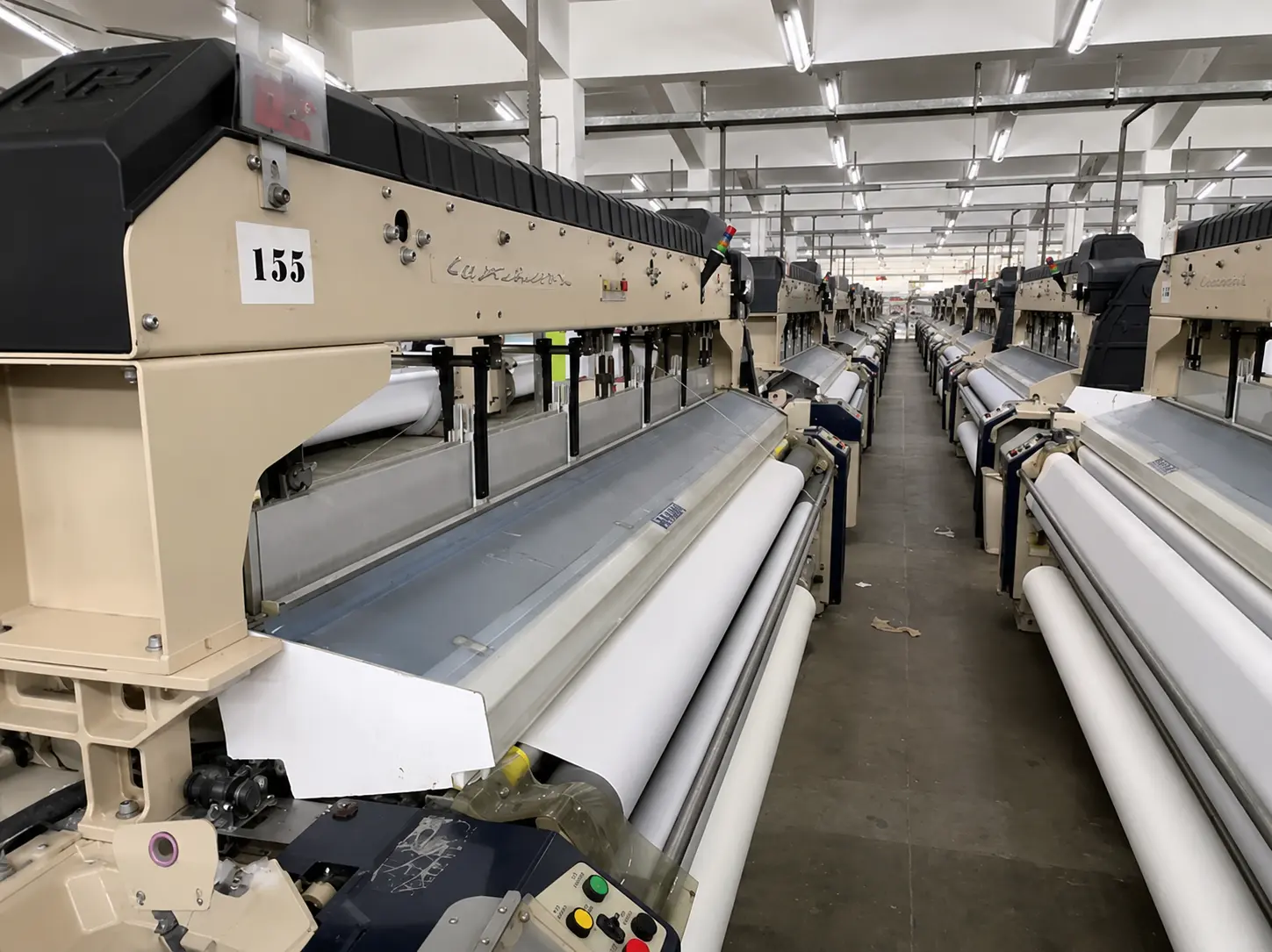
What Is a Water Jet Loom?
Water jet looms are among the fastest and most efficient weaving machines used in modern textile manufacturing. Instead of using air or a shuttle to insert the weft yarn, a water jet loom propels the yarn across the warp using a precisely controlled stream of water. This allows manufacturers to achieve exceptionally high production speeds while maintaining fabric consistency and reducing energy consumption for suitable materials. Water jet technology is widely adopted for weaving synthetic filament yarns such as polyester and nylon, where moisture does not affect the yarn properties.
When Is a Water Jet Loom the Right Choice?
A water jet loom is an excellent solution for manufacturers producing lightweight to medium-weight synthetic fabrics at high volumes.
Typical applications include:
- Polyester taffeta
- Lining fabrics
- Umbrella fabrics
- Down jacket fabrics
- Home textiles
- Sportswear fabrics
- Luggage and bag materials
- Industrial synthetic fabrics
Because water insertion creates very low friction during weft insertion, production speeds can exceed those of many conventional weaving methods while maintaining stable fabric quality.
Key Advantages of Water Jet Weaving
High Production Efficiency
Water jet looms are designed for continuous high-speed operation, making them ideal for factories focused on large-scale production.
Excellent Fabric Quality
Stable weft insertion helps reduce defects while producing uniform fabric surfaces and consistent weave structures.
Lower Operating Costs
Compared with some alternative weaving technologies, water jet looms generally require less compressed-air energy, helping manufacturers reduce operational expenses when processing compatible materials.
Reliable Operation
Modern water jet looms incorporate advanced electronic controls, optimized frame structures, and automatic monitoring systems to improve stability and minimize downtime.
Which Fabrics Can Be Produced?
Water jet technology performs best with hydrophobic filament yarns.
Common materials include:
- Polyester
- Nylon
- Microfiber
- Synthetic blends
- High-density technical fabrics
Natural fibers such as cotton, wool, or spun yarns are generally not suitable because they absorb water during the weaving process.
Choosing the Right Water Jet Loom
When evaluating a new weaving machine, manufacturers should consider:
- Required production capacity
- Fabric types
- Reed width
- Number of weft colors
- Shedding system (cam, dobby, or jacquard)
- Automation level
- Maintenance requirements
- Long-term operating costs
Selecting the right configuration ensures higher productivity while meeting the quality requirements of different textile applications.
Why Choose the HYX 508 Water Jet Loom?
The HYX 508 Water Jet Loom is engineered for manufacturers seeking reliable high-speed weaving performance and consistent fabric quality.
Its design supports efficient production of a wide range of synthetic fabrics while offering the flexibility required by modern textile mills. Combined with robust construction, advanced control systems, and dependable operation, the 508 helps manufacturers improve productivity and reduce overall manufacturing costs.
Whether producing apparel fabrics, technical textiles, or home textile materials, the HYX 508 is designed to deliver stable performance in demanding production environments.
Conclusion
Choosing the right weaving technology has a direct impact on productivity, operating costs, and product quality. For manufacturers specializing in synthetic filament fabrics, water jet weaving remains one of the most efficient and proven production methods available.
The HYX 508 Water Jet Loom combines speed, reliability, and precision to help textile manufacturers achieve consistent results while staying competitive in today’s global market.